

Can You Sell a House Before Probate? What the Law Says in California
Trying to sell a house before probate can feel overwhelming, especially during an already difficult time. In California, property owned solely by a deceased person generally cannot be sold until the probate process begins and the Superior Court appoints a personal representative. 1 This article explains what probate means under California law, when you can legally sell, and how estate planning tools like living trusts, joint tenancy, or revocable transfer-on-death deeds may help your family avoid court altogether. 3
Key Takeaways
- In California, you generally cannot sell a house owned only by the deceased until the Superior Court appoints an executor or administrator and issues Letters Testamentary or Letters of Administration. 1
- California allows revocable transfer-on-death deeds, living trusts, and joint tenancy with right of survivorship to transfer real property outside of probate.
- Selling without proper court authority risks title defects, rejected title insurance, and lawsuits from heirs or creditors.
- California's small estate affidavit threshold for real property is $184,500 (adjusted periodically), allowing some families to skip formal probate.
- California probate typically takes 9 to 18 months, and contested estates or complex assets can extend that timeline significantly. Always consult a California-licensed probate attorney before proceeding.
Understanding Probate and Property Sales in California
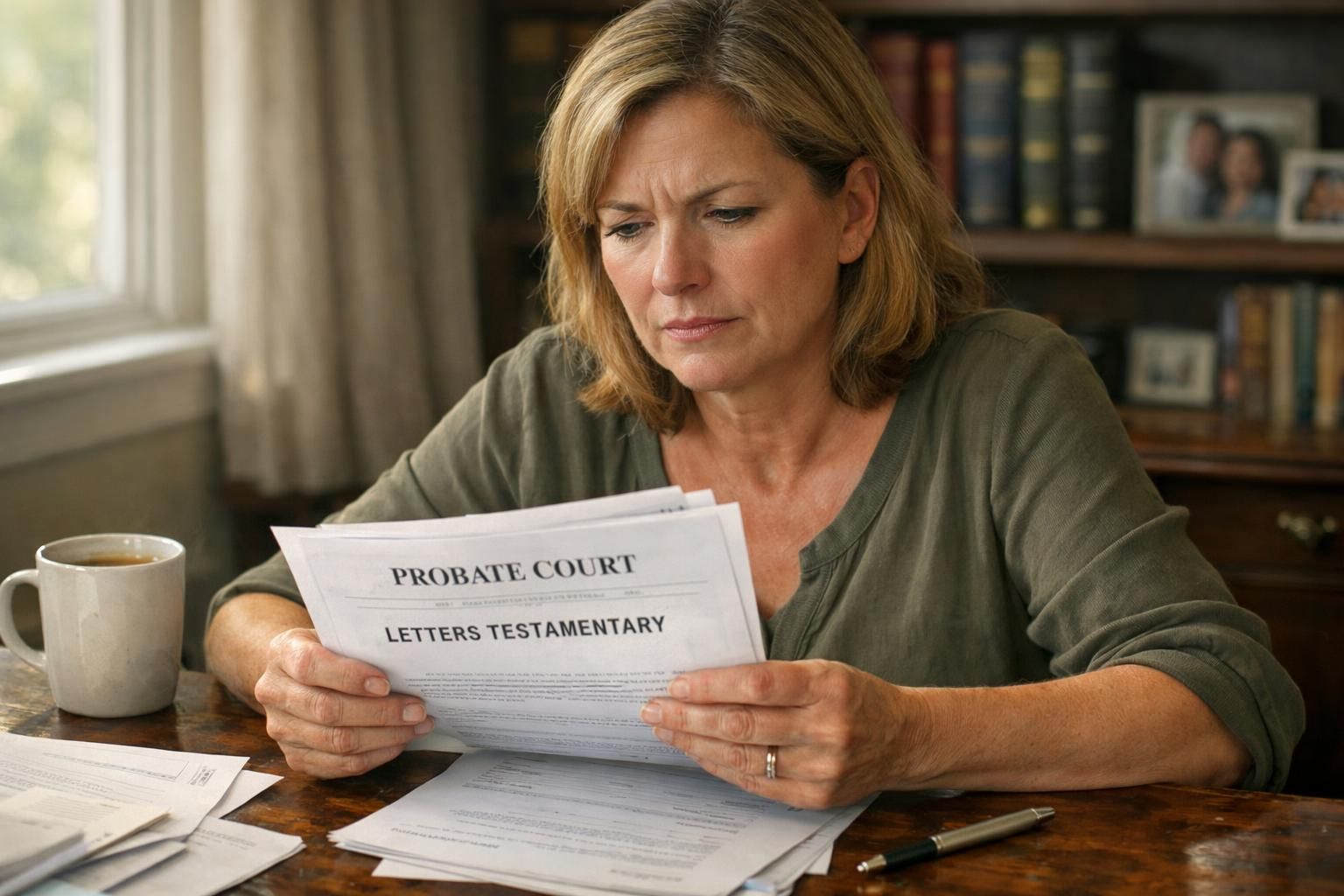
California probate law, found in the California Probate Code, governs how estate assets like a house are transferred after someone passes away. Key terms to understand include personal representative, probate court, and Letters Testamentary.
What is probate?
In California, probate is a court-supervised legal process that validates a will and authorizes a personal representative to manage and distribute a decedent's estate. The process takes place in the Superior Court of the county where the deceased lived — whether that is Los Angeles County, San Diego County, or Sacramento County. 1
During probate, the court verifies that debts and taxes are paid before assets pass to heirs or beneficiaries. If there is no will, California's intestate succession laws under the Probate Code determine who inherits. Most estates with solely owned real property must complete this process before any valid property transfer can occur.
Why is probate required before property sales in California?
California law requires probate to protect heirs, creditors, and buyers. Without it, no one has the legal authority to sign a deed on behalf of the estate. Title insurance companies will not insure a home with unresolved probate issues, and lenders will not fund a buyer's mortgage on such a property.
Skipping required steps can create title defects that cloud ownership for decades. Creditors also have a right to make claims against estate assets, and probate ensures those obligations are resolved before any distribution. If you attempt a sale without proper authority, you risk an invalid transaction and potential personal liability.
Key terms: executor, probate estate, Letters Testamentary
- The executor (or administrator if there is no will) is appointed by the California Superior Court to manage the estate — paying bills, filing taxes, and overseeing property sales.
- The probate estate includes all assets owned solely by the deceased that must pass through court supervision, such as a home titled only in their name. 2
- Letters Testamentary (or Letters of Administration) are official court documents giving the executor legal authority to act — including listing real estate for sale.
- Without these letters, title companies in California will refuse to insure the transaction and no legal sale can close.
- If no will exists, the court appoints an administrator, but the same requirement for court-issued letters applies before any property transfer. 2
When You CAN Sell Before Probate Closes in California

California law provides several estate planning tools that allow property to transfer outside of probate entirely. Using these options in advance can save families months of delays and thousands of dollars in court costs.
Joint tenancy with right of survivorship
When California real property is held in joint tenancy with right of survivorship, the surviving co-owner automatically inherits the deceased's share — no probate required. The surviving owner simply records an Affidavit of Death of Joint Tenant along with a certified death certificate at the county recorder's office, and title is cleared for sale.
This method is common among spouses and family members throughout the state. It allows a surviving owner in Los Angeles, San Francisco, or anywhere in California to sell the property quickly without waiting for court approval.
Revocable transfer-on-death deeds
California enacted the revocable transfer-on-death (TOD) deed, also called a revocable TOD deed, allowing property owners to name a beneficiary who receives real estate automatically at death. The deed must be properly executed, notarized, and recorded with the county recorder before the owner's death to be effective. 3
Once the owner passes, the named beneficiary records an affidavit and death certificate to confirm the transfer — bypassing probate entirely. The deed can be revoked at any time during the owner's lifetime, making it a flexible planning tool. California's TOD deed law does have specific eligibility rules, so consulting a California estate planning attorney is advisable. 3
Living trusts
A revocable living trust is one of the most widely used probate-avoidance tools in California, largely because the state's probate process is known for being lengthy and costly. When real property is properly titled into a living trust before death, it passes directly to beneficiaries under the trust's terms — no court involvement needed.
As successor trustee, you can sell a house held in the trust shortly after the grantor's death without petitioning the Superior Court or waiting for Letters Testamentary. The key is ensuring the property was actually transferred into the trust during the owner's lifetime. Many California families — especially in high-value markets like the San Francisco Bay Area and Los Angeles — rely on living trusts to protect their most significant asset.
Small estate affidavits in California
California allows heirs to use a simplified affidavit procedure for smaller estates. For real property, the gross value of the decedent's interest must not exceed $184,500 (this threshold is adjusted periodically under California law). If the estate qualifies, an heir may be able to use a court order for estates under the simplified procedures rather than full probate.
For personal property only (not real estate), a small estate affidavit may be used 40 days after death when the total value is under the threshold. Real property transfers typically require at least a petition to the Superior Court even under simplified procedures. Always verify current thresholds with a California probate attorney, as amounts are updated regularly.
Court-Supervised Sales During California Probate
When property must go through California probate, the sale is often subject to Superior Court supervision. California's Independent Administration of Estates Act (IAEA) can simplify this process for many estates — but only if all heirs consent.
Petitioning for authority to sell in California
To sell estate real property in California, the personal representative must follow these steps: 4
- File a petition for probate with the Superior Court in the county where the decedent resided, along with the original will (if any) and the death certificate.
- Obtain Letters Testamentary or Letters of Administration from the court, which grant legal authority to manage and sell estate assets.
- If selling under full court supervision, file a Report of Sale and Petition for Order Confirming Sale of Real Property with the court after accepting an offer.
- Provide written notice of the proposed sale to all heirs, beneficiaries, and creditors as required by California law.
- Attend the confirmation hearing where the court reviews the sale and may allow overbidding by other buyers.
- Under the IAEA, if the executor has full independent administration authority and no heir objects, court confirmation of the sale may be waived — significantly reducing timelines.
- Keep detailed records of all steps; California courts scrutinize executor conduct, and errors can result in personal liability. 4
Court confirmation and overbidding in California
One feature unique to California probate sales is the overbid process at the court confirmation hearing. After an executor accepts an offer, the court sets a minimum overbid amount — typically a percentage above the accepted offer. At the hearing, any qualified buyer may appear and outbid the original buyer.
This process protects the estate by ensuring a fair market price but can create uncertainty for buyers and delay closing. If the executor operates under IAEA authority, this step can often be avoided entirely, making the sale much smoother and faster.
Notice to heirs and handling objections in California
- California law requires formal written notice of the proposed sale to all heirs, beneficiaries, and creditors with claims against the estate. 5
- Heirs have the right to object within specific timeframes set by the California Probate Code; objections can trigger additional hearings.
- Unresolved objections can delay the sale for weeks or months and may require mediation or litigation in Superior Court.
- Failure to give proper notice can invalidate the sale and expose the executor to personal liability.
- Keep complete records of all notices sent and any responses received, as the court will review these during the confirmation hearing.
Risks of Selling Without Proper Authority in California

Invalid sales and title defects
Attempting to sell California real property before obtaining proper probate authority creates serious title problems. California title insurance companies will not issue policies on homes with unresolved probate issues recorded in county public records. Without title insurance, buyers cannot obtain mortgage financing, and closings collapse.
Courts can reverse unauthorized transfers, leaving both parties exposed to significant financial loss. Title defects created by improper probate sales can take years and substantial legal fees to resolve — and may surface only when the next owner tries to sell.
Personal liability for California executors
An executor who sells estate property without proper court authority or in violation of the California Probate Code can be held personally liable for resulting losses. The Superior Court may remove the executor, require restitution, and surcharge the executor for damages suffered by beneficiaries or creditors.
In cases of intentional misconduct, additional legal consequences may follow. Always secure a California probate attorney's guidance before taking any action involving estate real property.
Legal action from heirs or creditors
Heirs or creditors can petition the Superior Court to reverse an unauthorized sale, seek damages, or remove the personal representative. 5 Creditor claims are particularly significant in California, where estate creditors have a statutory right to be paid before distributions to heirs.
Disputes over unauthorized sales frequently drain estate funds and delay distributions to everyone involved. Securing proper authority before proceeding is the most effective way to protect yourself and the estate. 6
California Probate Timeline Expectations
Typical California probate timeframes
California probate is widely regarded as one of the more time-consuming processes in the country. A straightforward estate in Los Angeles or Sacramento typically takes 9 to 18 months from the initial filing to final distribution. Complex estates — those involving contested wills, multiple properties, or business interests — can extend well beyond two years. 7
The process generally includes: filing the petition and receiving a hearing date (1–3 months), publishing notice to creditors for the mandatory 4-month creditor claim period, inventorying and appraising assets, and then petitioning to sell real property and close. Court backlogs in larger counties like Los Angeles can add additional months to each phase. 8
Factors that speed up or delay California probate
- A clear, uncontested will with a named executor and IAEA authority significantly shortens the process by reducing required court appearances.
- Cooperation among all heirs and beneficiaries allows the personal representative to move efficiently through estate administration steps.
- Will contests or heir disputes can extend California probate by a year or more, especially if litigation reaches the Superior Court.
- Real property located in multiple California counties may require additional filings in each county, adding time and cost.
- Out-of-state real property triggers ancillary probate proceedings in that state, which run separately from the California case.
- Court backlogs vary significantly — San Francisco and Los Angeles courts often have longer wait times than smaller county courts.
- Missing or unclear title documents require extra verification steps before property can be sold.
- Large estates exceeding the federal estate tax exemption ($13.61 million in 2024) require IRS filings that add complexity and time.
- Using IAEA authority, when granted and when heirs agree, removes the need for court confirmation of property sales — the single biggest time-saver in California probate.
California-Specific Tax Considerations
California does not impose a separate state estate tax or inheritance tax, which simplifies the process compared to some other states. However, several important tax issues apply:
- Capital gains tax: Heirs who inherit California real property generally receive a stepped-up basis to fair market value at the date of death, which can significantly reduce or eliminate capital gains tax on a sale.
- Proposition 19: California's Proposition 19 (effective February 2021) limits property tax transfers between parents and children. Inherited property no longer automatically retains the parent's low assessed value unless the heir uses the home as their primary residence — and even then, only up to a capped amount. Executors in high-value markets like the Bay Area or Los Angeles should factor this into their planning.
- Documentary transfer tax: When estate property is sold, the county documentary transfer tax applies to the sale price. Rates vary by county and city.
- Federal estate tax: Estates exceeding the federal exemption threshold require a federal estate tax return (Form 706), which must be filed before final distribution.
Alternatives and Solutions for California Families
Family buyouts
When multiple heirs inherit California real property, one heir can buy out the others' shares rather than forcing a sale on the open market. All beneficiaries must agree on value — typically established through a professional appraisal — and the agreement must be properly documented under California law.
A California probate attorney can draft the necessary agreements and ensure the buyout complies with Probate Code requirements. This approach can preserve a family home while compensating other heirs fairly, and it avoids the delays and uncertainty of a court-supervised sale.
Estate advances
Estate advances allow California heirs to access a portion of their anticipated inheritance while probate continues. These advances are repaid from the estate distribution once the process concludes — not from the heir's personal funds. 5
This option can help cover immediate expenses such as property taxes, HOA fees, home maintenance, or attorney costs while waiting for probate to resolve. Always have a California probate attorney review any estate advance agreement before signing.
Selling to probate-experienced cash buyers
Some real estate buyers specialize in California probate transactions and understand the court confirmation process, IAEA procedures, and the timelines involved. These buyers typically offer cash and purchase properties as-is, removing the need for repairs or upgrades before sale. 9
A probate-experienced cash buyer will structure the contract to account for court approval timelines and other legal requirements — reducing risk for the estate and the personal representative. This can be especially helpful when the property is vacant, accumulating costs, or the estate needs to liquidate quickly. 9
What is Probate in California Real Estate
California probate is a Superior Court-supervised legal process that transfers real property ownership after someone dies. The court's probate division controls what happens to a house and other solely owned assets. 10 Without probate-avoidance tools in place — such as a living trust or joint tenancy — most California real estate owned solely by the deceased must pass through this process before any sale or transfer can occur.
The personal representative files the will and a petition with the local Superior Court, receives Letters Testamentary or Letters of Administration, then manages estate assets, satisfies creditors, and arranges for property distribution or sale. California's probate fees for executors and attorneys are set by statute as a percentage of the gross estate value, which means costs on high-value properties in markets like Los Angeles or San Francisco can be substantial. Working with an experienced California probate attorney helps protect your interests and avoid costly errors.
Conclusion
Selling a house before California probate closes presents real legal challenges — but understanding your options makes a significant difference. California law offers several effective tools, including living trusts, revocable TOD deeds, and joint tenancy, to help families avoid probate entirely when planned in advance. When probate is unavoidable, the Independent Administration of Estates Act can streamline the process and reduce the need for repeated court hearings.
If you are a personal representative managing an inherited property in California, consult a qualified probate attorney early to protect yourself and the estate. Taking the right steps from the start prevents title defects, creditor disputes, and costly delays.
If you need to sell an inherited California property quickly and want a straightforward, no-obligation cash offer, KDS Homebuyers works directly with executors and families navigating probate. Visit kdshomebuyers.net to request your free cash offer and learn how we can help simplify the process.
FAQs
1. Can a personal representative sell a house before California probate starts?
Generally, no. In California, the Superior Court must first appoint a personal representative and issue Letters Testamentary or Letters of Administration before any estate real property can legally be sold.
2. What happens if someone tries selling a California house before probate?
Attempting a sale without proper court authority can create title defects, void the transaction, and expose the seller to personal liability and lawsuits from heirs or creditors under the California Probate Code.
3. Does California allow transfer-on-death deeds to avoid probate?
Yes. California recognizes revocable transfer-on-death deeds, which allow property owners to name a beneficiary who receives real estate at death without going through probate — provided the deed was properly executed and recorded before death.
4. How does Proposition 19 affect inherited property in California?
Proposition 19 (effective February 2021) significantly limits property tax base transfers between parents and children. Inherited property generally no longer retains the parent's lower assessed value unless the heir occupies it as a primary residence, and even then limits apply. This can substantially increase property taxes on inherited homes in high-value areas.
5. Does selling probate property in California trigger capital gains tax?
Heirs typically receive a stepped-up basis to fair market value at the date of death, which can reduce or eliminate capital gains tax if the property is sold shortly after death. Consult a California tax professional for guidance specific to your situation.
References
- ^ https://www.mymetrotex.com/201738texas-probate-selling-an-estate-with-or-without-a-will/
- ^ https://www.mass.gov/probate-of-wills-and-estates
- ^ https://www.farrellfritz.com/insights/tax-tracker/transfer-on-death-deeds-adopted-by-new-york/ (2024-06-27)
- ^ https://legacyassuranceplan.com/articles/wills-probate/legal-requirements-when-selling-property-during-probate
- ^ https://www.ledbetterlawfl.com/selling-a-house-before-during-or-after-probate
- ^ https://www.heritagelawwi.com/can-i-sell-a-house-before-probate-is-complete
- ^ https://www.findlaw.com/estate/probate/probate-process-and-timeline.html (2025-07-24)
- ^ https://larsonbrown.law/2023/01/09/the-probate-timeline/
- ^ https://www.homehelpersgroup.com/can-you-sell-a-house-before-probate-what-to-know-now/ (2025-11-12)
- ^ https://selfhelp.courts.ca.gov/probate
