

Taxes on Selling an Inherited House: What You'll Owe in California

Losing a loved one is hard enough without worrying about taxes on selling an inherited house. One key fact: most people don't owe huge amounts because the property's value resets to its fair market price at the time of inheritance. 1 This guide explains what California heirs need to know — from stepped-up basis rules to capital gains, state taxes, and Proposition 19 — so you can avoid costly mistakes.
Key Takeaways
- The IRS uses a stepped-up basis for inherited houses. Your cost basis becomes the fair market value at the owner's death. You only pay capital gains tax on profit above that amount.
- Federal estate tax only applies if the estate exceeds $13.61 million per person in 2024. Most California heirs will not owe federal estate taxes.
- California has no separate state inheritance tax, but it does tax capital gains as ordinary income — with a top rate of 13.3%, one of the highest in the nation.
- Inherited property always qualifies for long-term capital gains rates (0%, 15%, or 20% federally), even if you sell quickly after inheriting.
- Proposition 19 significantly changed California property tax reassessment rules for inherited homes. Understanding this is critical before you decide to keep or sell.
- Keep all records: get a professional appraisal at date of death, save receipts for repairs and sale expenses, and consult a California estate planning attorney or CPA.
Understanding inherited property taxes can feel overwhelming during an already difficult time.
Selling an inherited house in California can trigger taxable income at both the federal and state level. Most heirs do not owe taxes until they actually sell, but California's high income tax rates mean your capital gains exposure can be significant. Unlike some states, California taxes capital gains as ordinary income — there is no separate lower rate at the state level.
Federal estate taxes generally only affect estates above $13.61 million in 2024. California does not have its own estate tax or inheritance tax. However, California's income tax on capital gains and its property tax reassessment rules under Proposition 19 can catch heirs off guard. Consulting a California CPA or estate planning attorney early helps reduce surprises.
The Stepped-Up Basis Concept
The IRS resets your cost basis to the home's fair market value at the owner's date of death. This rule, under Internal Revenue Code Section 1014, can greatly reduce your capital gains tax when you sell inherited property.
How the tax basis resets to the property's fair market value at the date of death.
If you inherit property, your tax basis resets to the fair market value (FMV) as of the decedent's date of death. For example, if your grandmother bought her Los Angeles home in 1980 for $50,000 and it was worth $800,000 when she passed away in 2023, your new cost basis is $800,000 — not $50,000.
As an heir, you only pay capital gains taxes on increases above this stepped-up basis. If you sell that house for $820,000, your taxable gain is just $20,000 rather than the entire appreciation since 1980. Executors may use an alternate valuation date up to six months after death (via IRS Form 706) if it benefits the estate. Per IRS Publication 551, special rules apply if someone gifted the home to the decedent less than a year before their passing.
Getting a certified appraisal at the date of death is essential in California, where property values in markets like San Francisco, Los Angeles, and San Diego can be substantial. An accurate FMV protects you during any IRS review and ensures your California Franchise Tax Board (FTB) filings are correct.
Example: Grandma bought the house for $50k in 1980, worth $800k at her death in 2023, sold for $820k — you owe tax on $20k, not $770k.
Suppose you inherit a house that your grandmother purchased for $50,000 in 1980. At her death in 2023, the property's fair market value steps up to $800,000. If you sell for $820,000, your taxable gain is only $20,000 — federally and at the California state level. The stepped-up basis shields you from taxes on all past appreciation before inheritance. Always review IRS Publication 551 and consult a California CPA for your specific situation.
Capital Gains Tax Rates

Federal capital gains tax on inherited property uses rates of 0%, 15%, or 20% depending on your taxable income. California adds its own income tax on top of that, making the combined rate one of the highest in the country.
Federal rates: 0%, 15%, or 20% — plus California's state income tax.
Federally, if your taxable income as a single filer is below $47,025 in 2024, you pay 0% capital gains tax. The 15% bracket applies up to $518,900 for single filers. Above that, the federal rate is 20%. High earners may also owe an additional 3.8% Net Investment Income Tax if individual income exceeds $200,000 (or $250,000 for joint filers).
California taxes capital gains as ordinary income — there is no preferential state rate. California's income tax rates range from 1% to 13.3%, with the top rate of 13.3% kicking in for income over $1 million. For many California heirs selling inherited property in a high-value market, the combined federal and state rate can approach or exceed 35%. Report federal gains on Form 1040 (Schedule D) and report California gains on your California Form 540.
Inherited property is always treated as long-term — no matter how quickly you sell.
The IRS always treats inherited property as having a long-term holding period, regardless of how soon you sell after inheriting. Even if you sell within days of inheriting, your gain qualifies for long-term federal capital gains rates. California, however, does not distinguish between short-term and long-term capital gains — all gains are taxed as ordinary income at the state level. Still, the long-term federal treatment is a meaningful benefit for California heirs given how high federal short-term rates can be.
Primary Residence Exclusion

Why the exclusion typically doesn't apply to inherited homes.
The IRS primary residence exclusion — $250,000 for single filers, $500,000 for married filing jointly — requires that you both own and live in the home as your primary residence for at least two of the five years before selling. Most California heirs do not move into the inherited property, so this exclusion generally does not apply. California conforms to the federal exclusion rules, so the state exclusion mirrors the federal one under these circumstances. 1
Exception: if you move in and live there for 2 of the past 5 years.
If you inherit a home and make it your California primary residence for at least two out of the five years before selling, you may qualify for the federal home sale exclusion under 26 U.S. Code Section 121 — and California's conforming exclusion. Save utility bills, tax returns showing your address, and other documentation to prove residency. This can significantly reduce or eliminate your combined federal and state capital gains tax liability.
California-Specific Tax Rules

No California inheritance tax or estate tax — but high income tax on gains.
California does not have a state inheritance tax or a state estate tax. You will not owe California any tax simply for receiving inherited property. However, when you sell, California taxes your capital gains as ordinary income through the Franchise Tax Board (FTB). With top marginal rates reaching 13.3%, California heirs selling high-value inherited homes in cities like San Francisco or Los Angeles need to plan carefully for the combined federal and state tax hit.
Proposition 19 and property tax reassessment — a critical California issue.
Before 2021, California's Proposition 58 allowed parents to transfer a primary residence to children without triggering a property tax reassessment under Proposition 13. Proposition 19, which took effect February 16, 2021, significantly narrowed this benefit.
Under Proposition 19, to avoid full reassessment, an inherited home must become the child's primary residence within one year. Even then, if the home's fair market value exceeds the parent's assessed value by more than $1 million, the assessed value is partially reassessed. If the heir does not move in and use the home as a primary residence, the property is fully reassessed to current market value, often resulting in a dramatic increase in annual property taxes.
For many California heirs, especially those inheriting homes in high-cost markets, Proposition 19 makes selling the inherited property the more financially practical choice rather than renting it out or holding it long-term.
Documentary transfer tax and local transfer fees.
California allows counties to charge a documentary transfer tax when real property is sold. The standard rate is $1.10 per $1,000 of the sale price, but cities can impose additional transfer taxes. For example, Los Angeles city charges an additional $4.50 per $1,000, and certain other municipalities have their own rates. These costs are typically deductible as selling expenses and reduce your taxable gain. Always confirm transfer tax rates with your escrow company or a California real estate attorney before closing.
Estate Taxes vs. Income Taxes
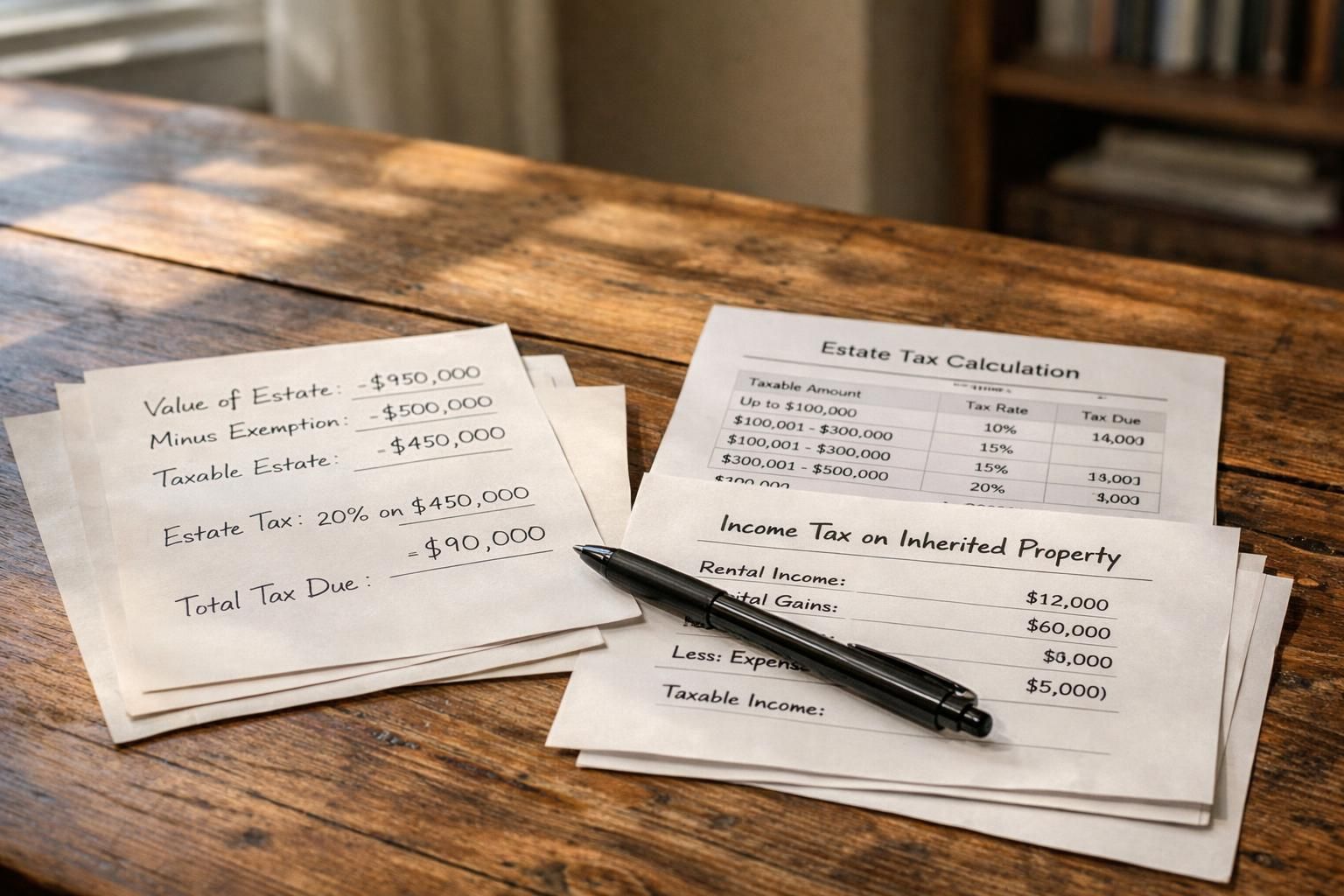
Federal estate tax exemption is $13.61 million per person in 2024.
Federal estate tax only applies if the total value of the estate exceeds $13.61 million per person in 2024 ($27.22 million for married couples). Only about 0.1% of estates owe federal estate tax. If an estate's gross value exceeds this threshold, the executor must file IRS Form 706 and pay tax on any amount above the exemption before assets pass to heirs. California does not impose its own estate tax, so there is no state-level estate tax to plan around.
Estates may still need to file returns.
Even if no federal estate tax is owed, large estates may still need to file Form 706 for portability elections or because gross asset values trigger filing requirements. The executor also files Form 8971 and Schedule A to establish the basis of inherited assets, which heirs must use consistently on their own returns. Work with a California probate attorney or CPA to confirm all filing requirements and deadlines under both federal rules and California Franchise Tax Board guidelines.
Multiple Heirs and Tax Implications
When a California home is inherited by multiple heirs, each person receives a stepped-up basis proportional to their ownership share. If three siblings each inherit one-third of a home worth $900,000 at death and later sell for $930,000, each reports one-third of the $30,000 gain — about $10,000 each — on their individual federal and California returns.
Use IRS Schedule D (Form 1040) and Form 8949 for federal reporting, and California Schedule D (Form 540) for state reporting. Deduct each heir's share of selling expenses such as agent commissions, escrow fees, and required repairs before calculating taxable gain. If heirs disagree on whether to sell, a California partition action through the Superior Court may be necessary — a process that can add time and legal costs.
Deductions You Can Claim
You can reduce your taxable gain by deducting legitimate selling costs and capital improvements. Real estate commissions (typically 5–6% of sale price), title insurance, escrow fees, attorney fees, California documentary transfer taxes, and required repairs reduce your gross proceeds. 2
Capital improvements made after inheriting — such as a new roof, HVAC system, or kitchen renovation — add to your stepped-up basis and further reduce taxable gain. Routine maintenance does not qualify. Keep all receipts and invoices. Property taxes paid on the inherited home after inheriting it may also be deductible. Your California CPA can help identify every eligible deduction under both federal and state rules.
Timing Considerations
The tax year in which you sell determines when you report the gain. If you close escrow in December 2024, you report the capital gain on your 2024 federal return (due April 2025) and your 2024 California Form 540. If you expect a large taxable gain, you may need to make estimated tax payments to both the IRS and the California Franchise Tax Board to avoid underpayment penalties. California requires estimated payments if you expect to owe more than $500 in state tax for the year. Work with a CPA to time your sale and manage estimated payments appropriately.
Special Situations
Inherited rental properties and depreciation recapture.
If you inherit a California rental property, you receive a new stepped-up basis equal to its fair market value at the date of death. You begin a fresh depreciation schedule using this new basis. If you rent the property before selling it, any post-inheritance depreciation deductions are subject to depreciation recapture tax at up to 25% federally upon sale. California also taxes this recaptured depreciation as ordinary income. Keep detailed records of your new basis and all post-inheritance depreciation claimed. IRS Publication 527 and California FTB guidance cover these rules for inherited rental properties.
Selling below the stepped-up basis (capital loss).
If you sell the inherited home for less than its stepped-up basis — which can happen in a declining local market — you may have a capital loss. This loss is deductible only if the property was used for investment or business purposes, not as a personal residence. Federally, you can deduct up to $3,000 in net capital losses per year against ordinary income, with excess losses carried forward. California follows similar rules. Document the date-of-death appraisal and final sale price carefully to support your loss deduction with both the IRS and the FTB.
Options for Selling Your Inherited California Home
California heirs have several options. Listing with a licensed California real estate agent works well if the home is in good condition and you want full market value, though the process typically takes 30–90 days or more including escrow. A traditional sale also involves agent commissions, escrow fees, and California transfer taxes.
If the home needs significant repairs, if multiple heirs need a quick resolution, or if the property is going through California probate, a cash buyer can speed up the process considerably. Cash sales can often close in days rather than months, avoiding ongoing carrying costs, property tax accumulation under Proposition 19's reassessment, and the complexity of managing an inherited property from a distance.
Whatever path you choose, discuss the tax implications with a California CPA or estate planning attorney before accepting any offer. Each heir's stepped-up basis, California income tax exposure, and Proposition 19 situation should factor into your decision.
Conclusion
Selling an inherited home in California involves federal capital gains rules, California's high income tax rates, Proposition 19's property tax reassessment changes, and potential probate requirements. The stepped-up basis is your most important tool for minimizing taxes. Get a certified appraisal at the date of death, document all improvements and selling costs, and work with a California CPA or estate planning attorney to navigate both the IRS and the Franchise Tax Board requirements.
If you'd like to skip the complexity of a traditional sale, KDS Homebuyers purchases inherited properties in California for cash — as-is, with no repairs or commissions required. Visit kdshomebuyers.net to request a free, no-obligation cash offer and learn how we can simplify the process during a difficult time.
FAQs
1. Does California have an inheritance tax or estate tax?
No. California does not impose a state inheritance tax or a state estate tax. However, California taxes capital gains from the sale of inherited property as ordinary income through the Franchise Tax Board, with rates up to 13.3%.
2. How does the stepped-up basis work for a California inherited home?
Your cost basis resets to the home's fair market value on the date of death. You only owe capital gains tax — federally and to California — on appreciation above that amount after you inherit the property.
3. How does Proposition 19 affect an inherited home in California?
Under Proposition 19 (effective February 16, 2021), an inherited home is fully reassessed for property tax purposes unless the heir moves in and uses it as their primary residence within one year. Even then, partial reassessment may apply if the market value exceeds the parent's assessed value by more than $1 million.
4. What California taxes apply when I sell an inherited house?
You will owe California income tax on any capital gain at your marginal income tax rate (up to 13.3%), plus federal capital gains tax (0%, 15%, or 20%) and potentially the 3.8% federal Net Investment Income Tax. California documentary transfer taxes also apply at closing.
5. Should I consult a professional before selling?
Yes. A California CPA, estate planning attorney, or probate attorney can help you understand your stepped-up basis, Proposition 19 implications, FTB filing requirements, and strategies to minimize your combined federal and state tax liability.
6. Can I claim a capital loss if I sell the inherited home for less than its stepped-up value?
Yes, if the property was held for investment or business purposes — not as a personal residence. You can deduct up to $3,000 in net capital losses per year against ordinary income federally, with remaining losses carried forward. California follows similar rules. Document your date-of-death appraisal carefully to support the loss.
