

How to Sell Your House Quickly for a Job Relocation in Washington
Facing a job relocation can make selling your Washington home feel urgent and stressful. Many employers offer a relocation package that can help, especially if it includes home sale assistance or a buyout option. 2 This guide covers practical steps to speed up your sale—from pricing strategy to understanding Washington's real estate market and working with a real estate agent or relocation company. 1
Key Takeaways
- Set a competitive asking price using a Comparative Market Analysis (CMA). Homes priced just below market value sell 20–30% faster and can generate multiple offers. Overpricing increases carrying costs and delays your relocation.
- Consider cash buyers or iBuyers if you have less than two months before your start date. Cash buyers close in as few as 7–14 days with over 95% certainty, though they typically pay 70–85% of market value.
- Focus on curb appeal and deep cleaning rather than major renovations. Simple improvements help attract buyers on Zillow and Redfin, which matters especially in competitive markets like Seattle and Bellevue.
- Washington state now permits Remote Online Notarization, making it possible to close your sale remotely if you've already moved to your new city.
- Leverage your employer's relocation package when possible. Benefits may cover agent commissions, closing costs, and Guaranteed Buyout (GBO) programs that minimize stress during tight deadlines.
Assess Your Timeline and Options

A clear timeline helps you pick the right selling strategy during a job relocation. Washington's real estate market varies considerably—Seattle and Bellevue tend to move faster than smaller markets like Olympia or Spokane—so understanding local conditions is essential.
Typical sale timelines: traditional listing vs cash sale
Understanding the difference between traditional home sales and cash transactions helps you choose the right path for your Washington relocation.
| Sale Method | Typical Timeline | Certainty of Closing | Common Hurdles | Best For |
|---|---|---|---|---|
| Traditional Listing (MLS & Realtor) | 30–60 days to close after accepting an offer | 75–80% close rate |
|
|
| iBuyer (Online Home Buyer) | 2–4 weeks | Over 90% close rate |
|
|
| Direct Cash Buyer | 7–14 days | 95%+ closing certainty |
|
|
In Washington, traditional sales managed through a licensed real estate agent are subject to state disclosure requirements and standard escrow processes handled through a title company. Cash buyers and iBuyers bypass many of these steps, closing in as little as one to two weeks—a major advantage when your start date is fixed.
Factors affecting speed: market conditions, property condition, season
Washington's real estate market is far from uniform. The greater Seattle and Bellevue areas often see multiple offers and short market times, while Spokane and the Tri-Cities tend to move at a steadier pace. A slow market can stretch timelines beyond 70 days, especially for unique properties.
Overpriced homes become red flags on the MLS and delay relocation plans while carrying costs mount. A comparative market analysis (CMA) from a local Washington agent helps you set realistic expectations.
Property condition matters significantly. Homes requiring substantial repairs take about 65% longer to sell and may not qualify for conventional financing, which limits your buyer pool. Washington's wet climate means buyers and inspectors pay close attention to roofs, drainage, and moisture issues—address these if possible before listing.
Seasonality also plays a role. Homes listed in spring or summer sell 20–30% faster than those listed in fall or winter. Washington's rainy season can dampen buyer enthusiasm and showing activity, making spring the preferred window for fast sales.
Decision tree: strategies for 4+ months vs under 2 months
- If you have more than four months, listing with a Washington real estate agent gives you time to maximize market value. Stage your home, complete a CMA, and use professional photography. Spring listings in King, Snohomish, or Pierce County tend to attract the most buyers.
- A traditional sale typically takes two to four months from listing to closing in Washington, with escrow handled by a title and escrow company.
- Bridge financing lets you purchase your new property sooner while waiting for your current Washington home to sell—particularly useful in the competitive Seattle metro.
- Simultaneous closings allow you to coordinate the sale of your existing home with the purchase of a new one on the same day. Your real estate agent and escrow officer can help plan this.
- Renting out your current home is an option if local rental demand supports it—Seattle and Tacoma have strong rental markets—but factor in landlord responsibilities and potential vacancy.
- With less than two months, prioritize speed. Consider cash buyers, iBuyers, or direct sales that close in one to four weeks.
- Guaranteed Buyout Programs through relocation companies provide a sale regardless of market conditions—valuable if you're on a hard deadline.
- Pricing slightly below recent comparable sales attracts competitive bidding and reduces the risk of carrying two mortgages simultaneously.
- A hybrid approach—starting with MLS exposure, then pivoting to a cash buyer if no offer arrives within an agreed window—balances price and certainty.
Prepare Your Home for a Fast Sale

A fresh coat of paint and tidy landscaping make a strong first impression. Professional staging and high-quality photography help you attract buyers fast, especially remote buyers relocating to Washington from out of state.
Focus on curb appeal and decluttering over major renovations
Tidy landscaping, a clean front yard, and simple touches like fresh mulch or trimmed shrubs help your home stand out. Power-washing the siding or painting the front door can meaningfully boost perceived value—important in Washington where homes are often viewed online before buyers ever schedule a tour.
Skip major renovations if you face a tight relocation deadline. Focus instead on deep cleaning, removing excess furniture, and decluttering. Staged homes attract more attention on Zillow and Redfin and generate faster offers. Minor cosmetic fixes save time while maximizing your return during a relocation sale.
Weigh ROI of repairs when time is limited
Homes needing repairs take about 65% longer to sell. 1 Focus only on repairs that build buyer confidence or satisfy lender requirements. In Washington, inspectors commonly flag roof condition, moisture intrusion, and electrical panels—these issues can stall financing approval and kill deals.
Avoid major renovations like full kitchen remodels if speed is the priority. Instead, handle smaller fixes that clear buyer objections and support a clean home inspection report. Weigh each repair's cost against the risk of extended carrying costs if your home sits unsold. 2 Your Washington real estate agent can advise on minimum improvements based on local market conditions.
Importance of staging and professional photography
Staging helps buyers—especially those relocating to Washington from other states—picture themselves in the home before they ever visit in person. Professional photography and virtual tours are essential when out-of-town buyers are making decisions remotely.
Staged homes can cut time on market by as much as 30% compared to unstaged ones. In Washington's competitive markets, technology-enabled listings with high-quality images and 3D tours give you a clear advantage. This investment pays off whether you're selling in Seattle's tight market or a mid-size city like Tacoma.
Pricing Strategy for Quick Sales

Set a competitive asking price using a comparative market analysis to attract serious buyers fast.
Competitive pricing vs aspirational pricing
| Aspect | Competitive Pricing | Aspirational Pricing |
|---|---|---|
| Definition | Sets price at or slightly below market value using CMA and agent data | Lists home higher hoping for top dollar |
| Sale Timeline | Homes sell 20–30% faster | Increased chance of extended market time |
| Buyer Interest | Maximum exposure; fits common search price bands | Limits buyer pool, especially in slower markets |
| Carrying Costs | Reduces dual mortgage risk | Longer timelines increase holding costs |
| Offer Activity | Creates urgency; can generate multiple offers | May require price reductions, hurting credibility |
| Market Fit | Works in all conditions, especially urgent relocations | Only works in very hot seller's markets |
In Washington, competitive pricing is especially effective in high-demand areas like King and Snohomish Counties, where well-priced homes routinely attract multiple offers. Overpricing risks a longer MLS stay, more price drops, and higher costs—a serious problem when your job start date is fixed.
Washington tax considerations when selling
Washington does not have a state income tax, but sellers should be aware of several relevant taxes. Washington imposes a Real Estate Excise Tax (REET) on home sales, paid by the seller at closing. The rate is graduated based on sale price, with higher-value homes subject to a higher percentage—a factor worth discussing with your escrow officer or tax advisor before listing.
Washington also enacted a state capital gains tax on certain investment gains above $262,000 (indexed annually), though the sale of a primary residence is generally exempt under the federal exclusion rules—up to $250,000 for single filers and $500,000 for married couples filing jointly, provided you've lived in the home two of the past five years. If your relocation is sudden and you haven't yet met that two-year threshold, consult a Washington tax professional before closing.
Cost considerations: carrying two mortgages or paying rent
Carrying two mortgages during a Washington relocation can cost $3,000–$6,000 or more each month when you factor in mortgage payments, property taxes, homeowners insurance, and utilities on both properties. Washington property taxes vary by county—King County rates differ significantly from Spokane County—so calculate your specific carrying costs early.
Bridge financing is available through many Washington lenders and can cover the gap between buying your new home and closing on your current one. Budget for at least one to two months of overlapping costs as a buffer, and check whether your employer's relocation package covers any dual-housing expenses.
Pricing slightly below market to attract quick offers
Setting your asking price just below comparable sales in your Washington neighborhood generates strong buyer interest. Homes priced slightly under market value often attract multiple offers quickly—especially in the Seattle metro—reducing the time you spend managing two properties.
Cash buyers typically offer 70–85% of market value but close in seven to fourteen days, eliminating financing contingencies and appraisal risk. While net proceeds are lower, you save on moving expenses, temporary housing, and carrying costs—often making the math work in your favor.
Traditional Listing vs Alternative Sale Methods

Washington sellers relocating for work have several paths available. Real estate agents, cash buyers, and direct sales each offer distinct advantages depending on your timeline.
Working with a realtor: pros and cons
- Washington real estate agents must be licensed through the Washington State Department of Licensing and are bound by state disclosure requirements—providing important protection for both parties.
- Strong local knowledge helps agents price your home accurately using CMA data from the Northwest Multiple Listing Service (NWMLS), which covers most of western Washington.
- Agents handle MLS exposure, showings, negotiations, mandatory seller disclosure forms (required under Washington law), and escrow coordination.
- Professional marketing—photography, staging, and virtual tours—improves results, particularly for out-of-state buyers considering Washington homes remotely.
- Agent commissions typically run 5–6% of the sale price. Some employer relocation packages cover this cost.
- Traditional sales carry risks: buyer financing contingencies, appraisal gaps, and inspection negotiations can delay your timeline when a job start date is fixed.
FSBO challenges for relocating Washington sellers
- Washington law requires sellers to complete a detailed Seller Disclosure Statement (Form 17). Errors or omissions can create legal liability—a significant risk when managing a sale remotely.
- FSBO listings don't appear on the NWMLS without agent involvement, severely limiting buyer exposure in Washington's largest markets.
- Managing showings, negotiations, and escrow paperwork from a different state adds complexity and increases the chance of delays or contract failures.
- Data from the National Association of Realtors shows FSBO homes remain on market an average of three weeks longer than agent-listed properties and typically sell for less. National Association of Realtors
- Without local support, tasks like coordinating Washington-required inspections and responding quickly to buyer requests become harder to manage from afar.
Alternative options: iBuyers, cash buyers, and direct sales
- iBuyers use Automated Valuation Models to provide quick online offers and can close in 7–14 days, eliminating showings and extended negotiations.
- Cash buyers pay approximately 70–85% of market value but deliver over 95% closing certainty—eliminating the risk of financing falling through. 3
- Most cash buyer transactions require no repairs, inspections, or staging, which is valuable when you need to move quickly and can't manage renovation projects remotely.
- You control the closing date—an important advantage when coordinating with a Washington employer's required start date or lease end date in your new city.
- A hybrid approach lets you list on MLS first, then pivot to a cash buyer if no offer materializes within your required window—balancing price and speed. 3
- Cash buyers operate across Washington's markets, from Seattle to Spokane, making them a reliable option regardless of local conditions or season.
Managing Logistics While Relocating
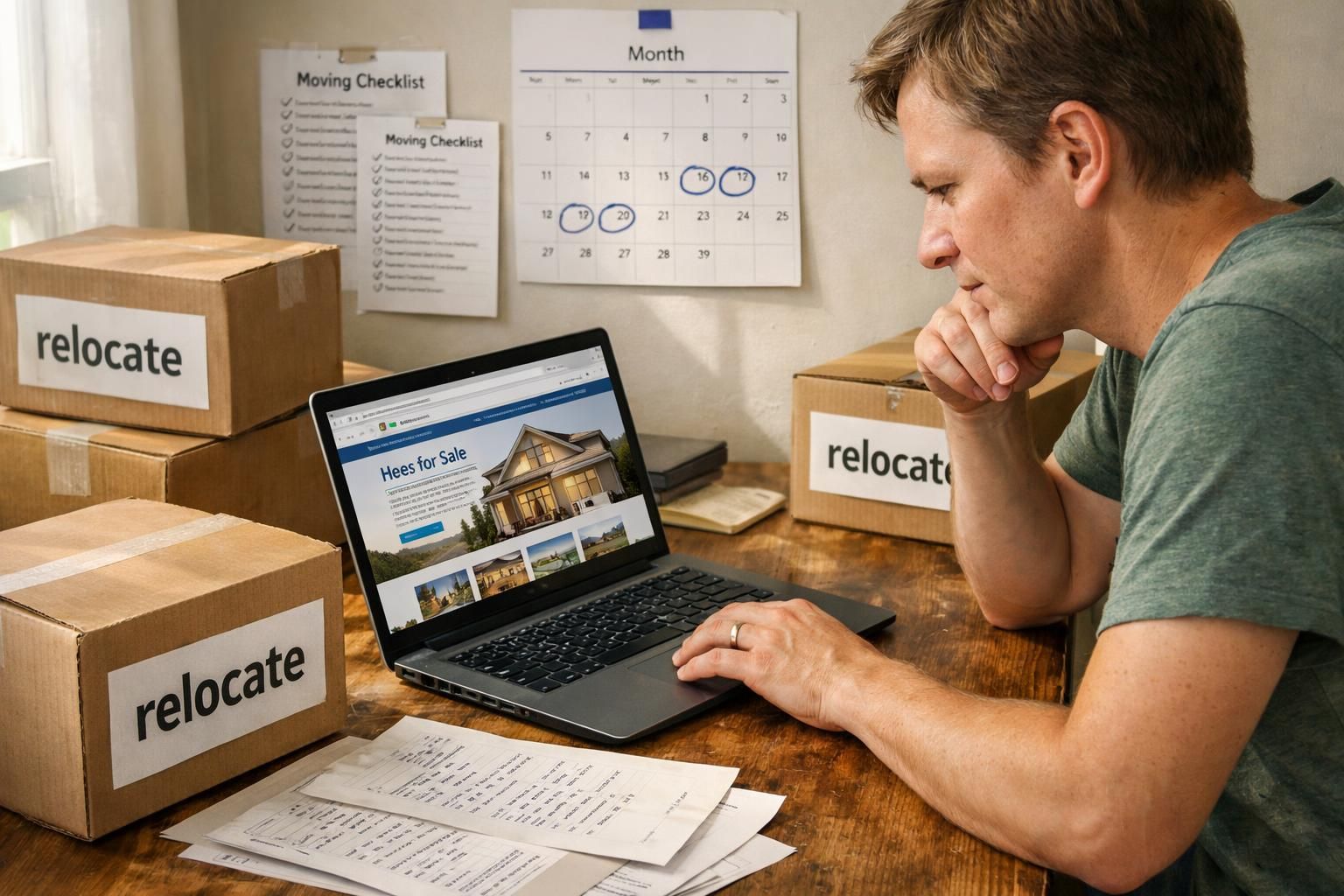
Coordinating your Washington home sale with a job relocation requires careful planning, especially if you face strict start-date deadlines. Remote tools and early communication with your agent and escrow officer can simplify the process considerably.
Coordinating closing dates with your move
- Talk to your real estate agent early to align your sale timeline with your employer's required relocation date. 5
- Budget for one to two months of possible dual mortgage or rent overlap if closing dates don't align perfectly. Washington's property tax schedule and utility costs factor into this calculation.
- Simultaneous closings—selling your current Washington home and buying your next one on the same day—are possible with careful coordination between agents and escrow officers. 4
- Closing delays can add $1,500–$3,000 or more per month in carrying costs. Build contingency time into your plan.
- Include specific vacate date terms in your sales contract to prevent conflicts at move-out.
Using remote closing options and handling utilities
- Washington permits Remote Online Notarization, allowing you to sign closing documents digitally from anywhere—valuable if you've already moved to your new city before your Washington home closes. 6
- A Power of Attorney can authorize a trusted party to sign closing documents in Washington on your behalf, further streamlining remote transactions.
- Work with your escrow company and real estate agent to use secure digital document platforms that reduce paperwork delays.
- Cancel Washington utilities—electric (often through Puget Sound Energy or Seattle City Light), water, gas, and internet—immediately after closing to avoid unnecessary charges.
- Update your address with USPS, your bank, and Washington State agencies promptly after closing.
- Request direct deposit for sale proceeds so funds are accessible without requiring a return trip to Washington.
Managing belongings if closing happens before departure
- Use moving companies that offer temporary storage, which is especially practical when early closing dates push you out before your new Washington or out-of-state home is ready.
- Portable storage containers offer flexibility and easy access to belongings during the transition period.
- Confirm with your employer whether storage costs are reimbursable under your relocation benefits package.
- Consider short-term rentals or extended-stay housing in your departure or destination city if you need to bridge a gap between closing and your move-in date.
- Ask your real estate agent or relocation coordinator for trusted referrals to movers, packers, and storage providers familiar with Washington logistics.
Conclusion
Selling your Washington home quickly for a job relocation is achievable with the right strategy. Review your relocation package, understand local market conditions in your area—whether that's Seattle, Tacoma, or Spokane—and choose a sale method that fits your timeline. Lean on experienced Washington real estate agents or explore cash buyer options to speed things up. With careful planning, you can close one chapter and start your next one with confidence.
FAQs
1. What steps can help me sell my Washington home fast during a job relocation?
Start with a comparative market analysis to set the right price for your local market. Boost curb appeal, address inspection-ready repairs, and work with a Washington agent familiar with the NWMLS and state disclosure requirements.
2. How does a relocation package support selling my house in Washington?
A relocation package may cover agent commissions, Washington's Real Estate Excise Tax (REET), moving expenses, or temporary housing while your property sells. Some employers partner with relocation companies for additional support.
3. Should I stage my home before selling due to job relocation?
Yes. Staged homes sell faster and attract more buyers, including out-of-state buyers relocating to Washington who rely on virtual tours and professional photos to make decisions remotely.
4. Can bridge financing help if I need to move before my Washington home sells?
Yes. Bridge loans—available through many Washington lenders—let you access home equity to cover costs or purchase a new property before your current home closes.
5. Will selling quickly affect my Washington tax obligations?
Washington does not have a state income tax, but sellers pay the Real Estate Excise Tax (REET) at closing. If you haven't lived in the home two of the past five years, you may not qualify for the full federal capital gains exclusion. Consult a Washington tax professional before closing.
6. Is renting out my Washington property better than selling when relocating for work?
Renting can work if local demand supports it—Seattle and Tacoma have strong rental markets—but factor in property management costs, vacancy risk, and your ability to manage landlord responsibilities from another state.
References
- ^ https://realestate.usnews.com/real-estate/articles/secrets-to-selling-your-home-faster
- ^ https://www.researchgate.net/publication/357003891_Selling_Prices_and_Time_on_the_Market_of_Houses_Sold_through_Relocation_Management_Companies
- ^ https://upigroupllc.com/how-to-sell-your-house-fast-cash-offers-vs-traditional-listings/
- ^ https://www.edconstable.com/best-practices-for-aligning-closing-dates-when-moving-long-distance/ (2024-07-11)
- ^ https://www.alabamarealtors.com/posts/2024/05/07/selling-your-home-during-a-relocation-tips-for-a-smooth-transition
- ^ https://www.sciencedirect.com/science/article/pii/S0166046222000011
- ^ https://www.redfin.com/blog/selling-home-for-job-relocation/ (2025-08-25)
- ^ https://ibuyer.com/blog/selling-your-house-due-to-job-changes/ (2024-11-20)
If you're facing a job relocation and need to sell your Washington home quickly, KDS Homebuyers can help. We buy houses directly for cash, in any condition, with no repairs, commissions, or hidden fees—and we can close on your schedule. Visit kdshomebuyers.net today to get a free, no-obligation cash offer and take one major item off your relocation checklist.
