

Real Estate Transfer Tax: What Sellers Need to Know in Colorado
Selling your home in Colorado comes with closing costs that can catch you off guard, including the state's real estate transfer tax. 3 This is a one-time fee charged when property ownership transfers from one party to another. In this guide, you'll learn how Colorado's transfer tax works, who pays it, and how to plan for it before closing day. 2
Key Takeaways
- Colorado charges one of the lowest real estate transfer taxes in the country — just $0.01 per $100 of sale price, which equals $30 on a $300,000 home.
- The tax is typically paid by the seller at closing and deducted directly from sale proceeds.
- Some Colorado counties and municipalities may layer additional local transfer fees on top of the state rate — always confirm with your title company.
- Transfer taxes are not deductible from your federal or Colorado income tax but may increase your cost basis for capital gains calculations.
- Exemptions exist for family transfers, divorce settlements, inherited properties, and certain trust arrangements — but documentation is required.
Sources: Colorado Department of Revenue; state government websites; IRS guidelines as of 2025.
What is a Real Estate Transfer Tax?
A real estate transfer tax is a one-time fee paid when transferring ownership of real property — such as your home or investment property. Colorado and other states use various names for this charge, including deed transfer tax, documentary fee, or excise tax.
This tax is separate from your annual property taxes or any federal estate tax. In Colorado, the amount is based on the sale price of the property, not its assessed value. The state collects these funds to support public services, and the tax is paid at closing during the title transfer process — not annually.
Only state or local authorities collect transfer taxes; the IRS does not. Understanding Colorado's structure — and whether your county or city adds its own fees — helps you avoid surprises on closing day.
Who Pays the Transfer Tax, and When Is It Paid?
In Colorado, the seller typically pays the real estate transfer tax, though this can be negotiated in the purchase contract. The tax is always collected at closing when the deed is recorded and title transfers to the buyer.
Your title company or closing attorney calculates the amount using the sale price. The funds come directly from your sale proceeds and appear as a line item on your Closing Disclosure — you don't need to bring a separate check. This ensures compliance with Colorado law before ownership officially changes hands.
How Are Transfer Taxes Calculated?

Colorado uses a flat-rate structure for its statewide transfer tax. Knowing how this works before you list your property helps you plan your net proceeds accurately.
Colorado's Flat-Rate Structure
Colorado charges a flat rate of $0.01 per $100 of the property's sale price. This is one of the lowest transfer tax rates in the nation. Unlike states such as Washington D.C. (which charges 2.2%–2.9%) or Delaware (up to 4%), Colorado's rate creates only a minimal obligation for most sellers.
Some Colorado municipalities or resort communities — such as Breckenridge, Telluride, and Snowmass Village — impose their own additional real estate transfer assessments (RETAs) on top of the state rate. These local fees can be significantly higher, sometimes reaching 1%–2% of the sale price, so sellers in ski resort areas should always verify local requirements with their title company.
Example Calculation for a $300,000 Home in Colorado
At Colorado's statewide rate of $0.01 per $100, the transfer tax on a $300,000 home is just $30. On a $500,000 home, you'd owe $50 at the state level. Compare this to neighboring states or higher-tax jurisdictions:
| Location | Transfer Tax Rate | Tax on $300,000 Home | Notes |
|---|---|---|---|
| Colorado (state) | $0.01 per $100 | $30 | Statewide; very low rate |
| Colorado resort towns | Up to ~2% (local RETA) | Up to ~$6,000 | Varies by municipality |
| Florida | $0.70 per $100 | $2,100 | Documentary Stamp Tax |
| California | $1.10 per $1,000 | $330 | County-level; cities may add fees |
| New York State | $2 per $500 | $1,200 | NYC adds additional local taxes |
| Washington D.C. | 2.2%–2.9% | $6,600–$8,700 | Among the highest in the country |
| Delaware | Up to 4% | Up to $12,000 | Among the highest state maximums |
Your Closing Disclosure will list these charges clearly. If you're selling in a Colorado resort community or within city limits in Denver or Aurora, ask your closing agent for a full fee breakdown.
State and Local Variations in Colorado

While Colorado's statewide transfer tax is minimal, local layers can add up depending on where your property is located.
Colorado's Low Statewide Rate vs. Local Fees
Colorado's $0.01 per $100 statewide transfer tax is straightforward for most sellers in cities like Denver, Colorado Springs, Aurora, and Lakewood. However, resort and mountain communities are a different story. Towns like Telluride, Breckenridge, and Snowmass Village have authorized real estate transfer assessments that apply separately from the state rate. These local fees fund community housing programs and open space preservation.
If you're selling in a mountain resort community, you may owe significantly more at closing than the state's nominal fee suggests. Always ask your title company or closing attorney whether a local RETA applies to your property before listing.
States with No Transfer Tax (For Comparison)
Colorado's rate is so low it's nearly comparable to states with no transfer tax at all. States including Texas, Idaho, Montana, Wyoming, and Utah impose no real estate transfer tax, which makes property transactions in those markets especially affordable. Colorado's statewide rate is low enough that it rarely affects seller net proceeds in any meaningful way — unless a local municipal fee applies.
Who Is Responsible for Paying the Transfer Tax?
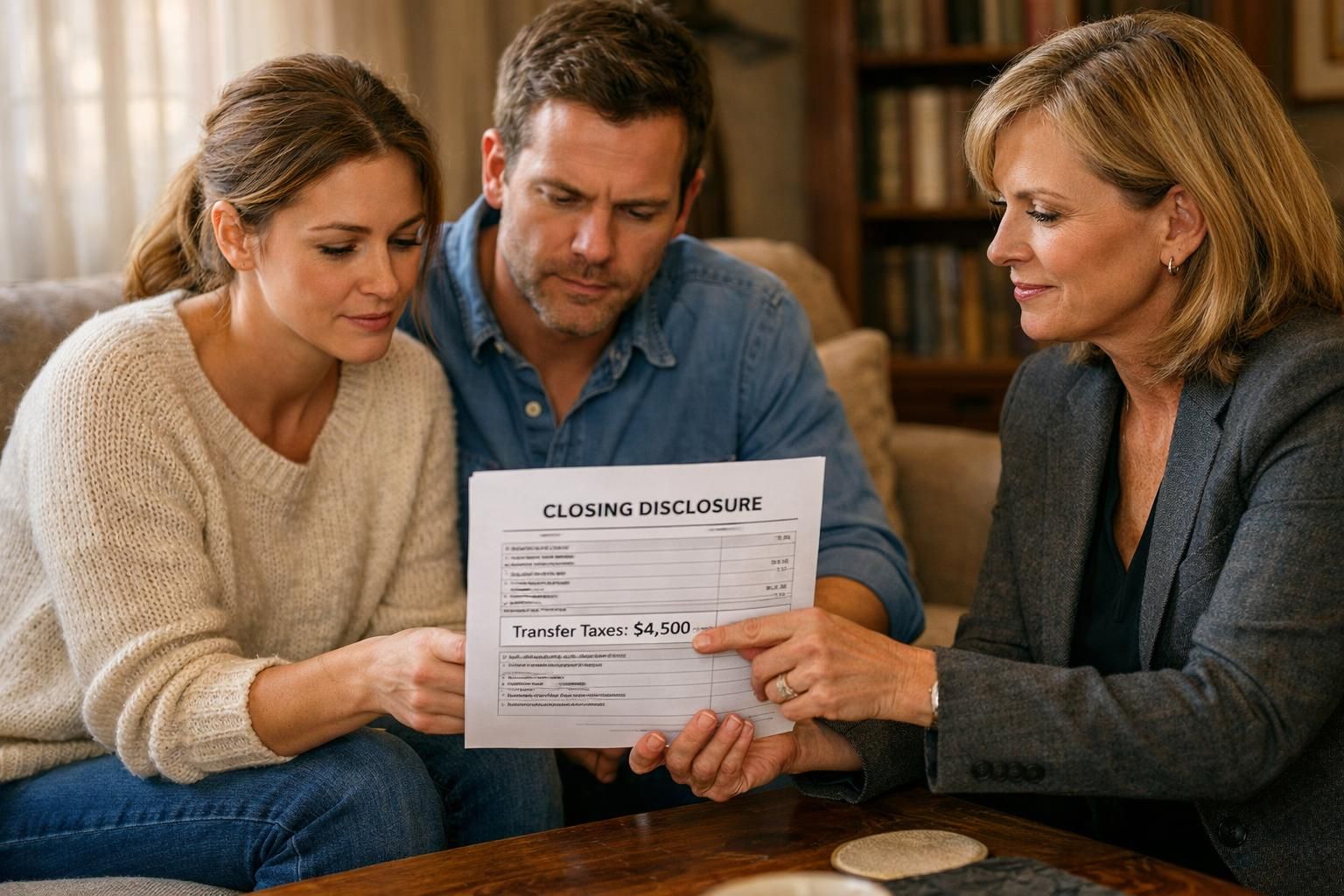
In Colorado, the seller customarily pays the state transfer tax, though the purchase contract can shift that responsibility. Local customs and negotiation between buyer and seller both play a role in the final agreement.
Local Customs and Negotiation in Colorado
In Colorado's competitive real estate markets — particularly in the Denver metro area and along the Front Range — buyers sometimes offer to cover a portion of closing costs, including transfer taxes, to strengthen their offer. In resort markets, the local RETA is typically paid by the buyer, though this can vary by contract terms.
Your Colorado real estate agent or closing attorney can tell you what is customary in your specific county or city. The Colorado Contract to Buy and Sell Real Estate, the standard form used in most transactions, has provisions for allocating closing costs — review this section carefully with your agent.
How Transfer Taxes Appear on the Closing Disclosure
Colorado transfer taxes appear as a separate line item under "Other Costs" on your Closing Disclosure. The title company calculates the exact amount based on the sale price and lists it clearly so both parties know what is owed. The payment is deducted from your net proceeds at closing and remitted directly to the appropriate state or local authority. Double-check this section to ensure any applicable local RETA is also captured accurately.
Exemptions to Transfer Taxes in Colorado

Colorado law provides exemptions from the real estate transfer tax in certain circumstances. Understanding these can help you avoid unnecessary costs and prepare the right documentation before closing.
Family Transfers and Divorce Settlements
Transfers of real property between family members — such as parent to child or between spouses — may qualify for a transfer tax exemption under Colorado law. Divorce settlements that legally require a title transfer also commonly meet state guidelines for exemption.
- You will typically need to provide supporting legal documents, such as a divorce decree or court order, to claim the exemption at closing.
- Colorado may still require a deed to be recorded and appropriate forms submitted even when no money changes hands.
- If the property is later sold to an unrelated third party, standard transfer taxes will apply to that transaction.
- Always confirm exemption eligibility with your closing agent or a Colorado real estate attorney before closing day.
Inheritance, Trusts, and Probate Transfers
Property passing to heirs through inheritance or probate in Colorado is often exempt from the state transfer tax. If you inherit a home and need to sell it, Colorado's probate process — handled through the district court in the county where the property is located — must be completed before the title can transfer to a buyer.
- Certified probate records or letters testamentary are typically required at closing to document your authority to sell as an executor or heir.
- Transferring property into or out of a revocable living trust may also qualify for transfer tax exemption, provided you remain both the grantor and the beneficial owner.
- For 2025, the federal estate tax exemption is $13.99 million per individual. Colorado does not have a separate state estate tax, which simplifies planning for most Colorado homeowners.
- If you inherit a Colorado home and sell it, the IRS "step-up in basis" rule typically resets your cost basis to the fair market value at the date of death — this can significantly reduce capital gains tax on the sale.
- Confirm all documentation requirements with your title company before listing an inherited Colorado property.
Special Situations Impacting Transfer Taxes in Colorado

Mortgaged Properties and Cash Sales
Colorado's transfer tax applies to all property sales regardless of how the buyer pays. Whether your buyer is financing through a lender or paying cash, the tax is calculated on the full sale price — not your remaining equity or loan balance. A title company will account for any outstanding liens and mortgage payoffs separately from the transfer tax calculation.
Cash sales are common in Colorado's competitive markets and do not reduce your transfer tax obligation. The presence of a HELOC or second mortgage does not change what the state or any local municipality collects at closing.
Selling to Investors, Short Sales, and Foreclosures
Colorado's transfer tax applies whether you sell to an individual buyer, an investor, or through a short sale. If your property goes through foreclosure, transfer tax rules still apply to the deed transfer unless a specific legal exemption covers your situation.
- Investor and cash sales are taxed at the same rate as any other residential transaction in Colorado.
- Short sale proceeds are taxed based on the actual sale price, even if that price is below the outstanding mortgage balance.
- If ownership is held through an LLC or corporation, transferring a controlling interest in that entity may trigger transfer tax obligations based on the fair market value of the underlying real property.
- All transfer taxes are deducted at closing and itemized on your Closing Disclosure, regardless of the sale structure.
Tax Considerations for Colorado Sellers
Colorado's transfer tax cannot be deducted from your federal or Colorado state income tax return. However, it may be added to your property's cost basis, which can reduce capital gains when you sell.
Colorado conforms to many federal income tax rules. If you sell your primary residence, you may qualify for the federal capital gains exclusion — up to $250,000 for single filers and $500,000 for married couples filing jointly — provided you meet the IRS ownership and use tests. Colorado taxes capital gains as ordinary income at the state level, so understanding your gain after adjusting for your cost basis (including transfer taxes paid) is important.
If you sell Colorado real estate as a nonresident, Colorado requires withholding of state income tax on the gain unless an exemption applies. Your closing agent or a Colorado tax professional can help you navigate this requirement.
The IRS sets the 2025 gift tax exclusion at $19,000 per person. If you transfer property without adequate compensation — such as selling a home to a family member well below market value — gift tax rules may apply in addition to, or instead of, typical transfer tax treatment.
Conclusion
Colorado's statewide real estate transfer tax is among the lowest in the country, making it rarely a major closing cost for Front Range sellers. That said, resort and mountain community sellers need to check for local transfer assessments that can add significantly to closing costs. Always review your Closing Disclosure carefully, confirm whether any exemptions apply to your situation, and factor transfer taxes — state and local — into your net proceeds calculation from the start.
How to Find Your Colorado Transfer Tax Rate
Visit the Colorado Department of Revenue website or your county assessor's and treasurer's offices online for current information. Your title company will also have up-to-date rates for both the state and any applicable municipal fees. For resort properties, contact the local municipality directly or ask your closing attorney for a complete fee schedule before listing.
Questions to Ask Your Colorado Closing Agent
Ask your closing agent whether any local RETA or municipal transfer fee applies to your property in addition to the state rate. Confirm which party — buyer or seller — is responsible under your contract. Ask how the tax will appear on your Closing Disclosure and whether any exemptions apply to your specific sale, such as a family transfer or inherited property. Find out if there have been any recent changes to local rates in your area.
Factoring Transfer Taxes Into Your Net Proceeds
For most Colorado sellers in cities like Denver, Aurora, or Colorado Springs, the state transfer tax is a negligible closing cost — just $30 on a $300,000 sale. However, if you're selling in a mountain resort community, a local RETA could cost thousands. Always include all applicable transfer taxes — state and local — in your net proceeds calculation before accepting an offer. 3 Your title company can provide a seller's estimated net sheet that breaks down every fee so you know exactly what you'll walk away with after closing.
FAQs
1. What is Colorado's real estate transfer tax rate?
Colorado charges $0.01 per $100 of the sale price statewide. On a $400,000 home, that's just $40. Some Colorado resort municipalities charge additional local transfer fees that can be significantly higher.
2. Who pays the transfer tax when selling a home in Colorado?
The seller typically pays Colorado's state transfer tax, though the purchase contract can allocate responsibility differently. In resort communities, local RETAs are sometimes paid by the buyer — confirm this with your closing agent.
3. Are there exemptions to Colorado's real estate transfer tax?
Yes. Transfers between spouses, family members, through divorce settlements, and certain trust or probate transfers may qualify for exemptions. Documentation such as court orders or probate records is required to claim these exemptions.
4. Does Colorado have a state estate tax?
No. Colorado does not impose a state estate or inheritance tax, which simplifies estate planning for most Colorado homeowners. Federal estate tax rules still apply for large estates above the federal exemption threshold.
5. Can the transfer tax be deducted on my Colorado income tax return?
No. Transfer taxes are not deductible on your Colorado or federal income tax return. However, they can be added to your property's cost basis, which may reduce your taxable capital gain when you sell.
6. What happens to transfer taxes in a short sale or foreclosure in Colorado?
Transfer taxes still apply in short sales and foreclosures. The tax is calculated on the actual sale price, and a legal exemption must be established to avoid the tax — simply selling below your mortgage balance does not exempt you.
References
- ^ https://gwipp.gwu.edu/sites/g/files/zaxdzs6111/files/downloads/Real%20Estate%20Transfer%20Taxes-%20Widely%20Used%2C%20Little%20Conformity.pdf
- ^ https://narfocus.com/publication-issue/view/2023-07-05-state-and-local-issues-real-estate-transfer-tax
- ^ https://www.bankrate.com/real-estate/transfer-taxes/
If you're a Colorado homeowner looking to sell without the uncertainty of traditional closing costs, KDS Homebuyers purchases houses directly for cash — no agent commissions, no lengthy negotiations. Visit kdshomebuyers.net to request a free, no-obligation cash offer today.
